Rethinking personalisation for myFT
A new direction for helping readers discover relevant journalism without taking away editorial judgement or user control
AT A GLANCE
Organisation: Financial Times | myFT
Focus: Product strategy, personalisation, information architecture, mobile & web
cross-platform consistency, discovery & concept development.
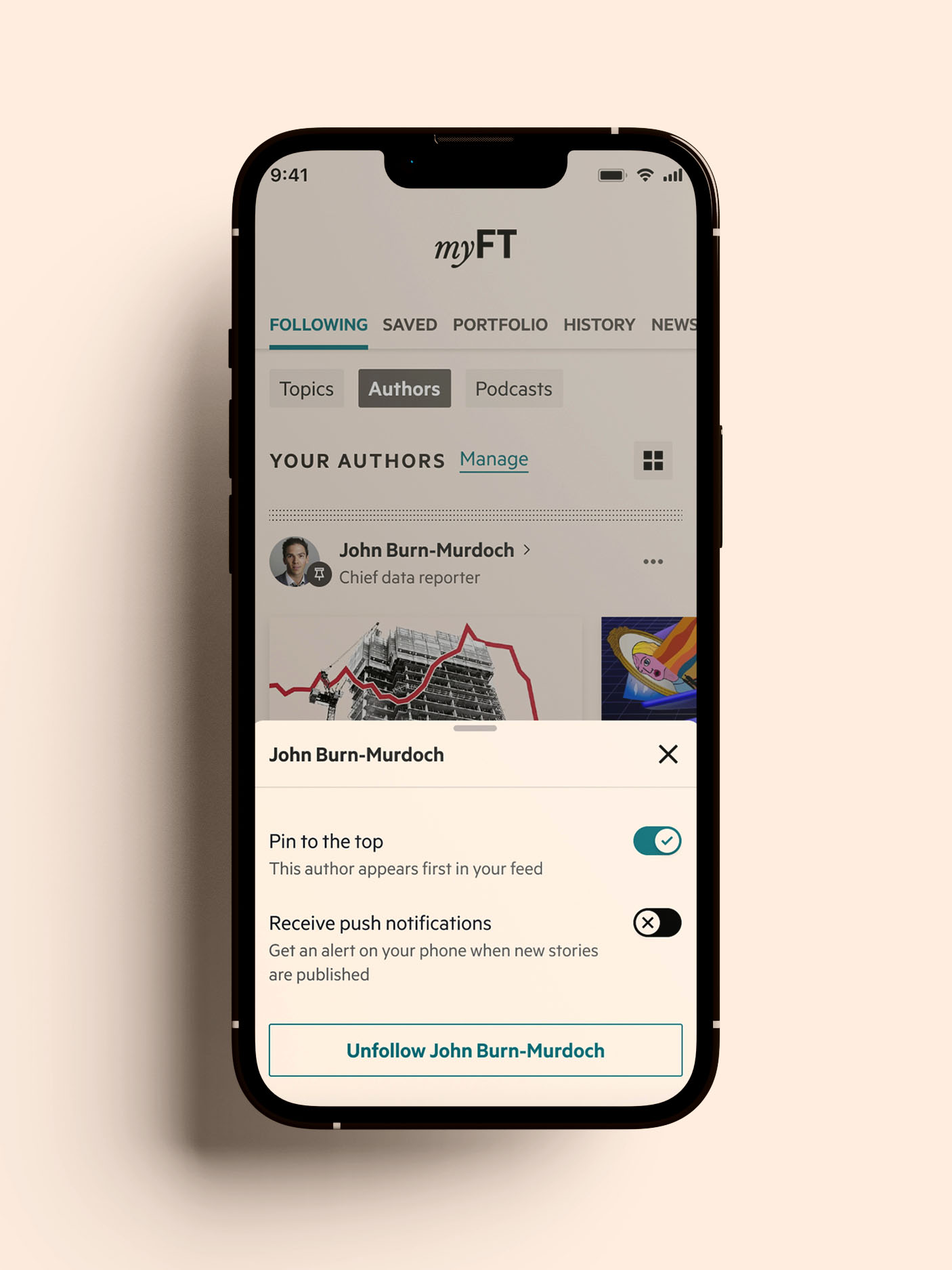
myFT is the Financial Times' personalisation experience, where readers can follow topics, authors, newsletters and other interests, save articles, and shape the news around what matters to them.
Despite being one of the FT's most valuable products for reader engagement, it had evolved incrementally over more than a decade, resulting in fragmented experiences, inconsistent interaction patterns and an increasingly difficult technical foundation.
Rather than redesigning individual features, the project set out to establish a clearer vision and direction for how personalisation could support FT readers in the future. This work ultimately became the starting point for what we called the Thoughtful Assistant.
CHALLENGES
An increasingly complex product
Discovery was an ongoing process. We reviewed previous research and existing product knowledge, but many of myFT's nuances only became apparent as we explored the experience in greater depth and worked with engineers to understand how different parts of the product actually functioned.
Different readers, different expectations
We were particularly interested in less frequent readers who might visit the FT once or twice a week and use it as a secondary news source. For these readers, myFT needed to make relevant journalism easier to discover.
At the same time, we had to preserve the experience of habitual readers who had built strong routines around myFT. These readers often valued editorial curation and explicit control over what they followed, and were less comfortable with algorithmic recommendations taking over that role. The challenge was to make personalisation more useful without making it feel more intrusive or automated.
A mature technical estate
The product had evolved over many years, leaving a complex technical foundation and limitations around what could be changed or introduced. Design decisions therefore needed to work within today's capabilities while still supporting a longer-term product direction.
Designing across disciplines
We worked closely with research, engineering and data science throughout the project. This was particularly important when exploring how existing recommendation capabilities could be improved and how they might eventually support a more thoughtful form of personalisation.
APPROACH
We started with a design sprint to understand the product, align around the broader strategy and explore possible directions.
FROM FILING CABINET TO THOUGHTFUL ASSISTANT
Traditionally, myFT functioned more like a filing cabinet: a place where readers manually organised the topics they wanted to follow. We explored how it could become more useful without taking control away from the reader.
TRUSTED ASSISTANT NOW, THOUGHTFUL OVER TIME
The full Thoughtful Assistant vision depended on capabilities that weren't yet available, so the first phase focused on what we could realistically improve with the existing product.
From passive to proactive
What we could do
Preserve reader agency
What wasn't yet possible
Build towards the future
TESTING & LEARNING
We tested parts of the new experience through A/B experimentation, including a new navigation model that gave followed categories greater visibility.
What we learned
OUTCOMES
REFLECTIONS
About me
I am a designer based in Bulgaria.I love typography, squares, negative space, and almost anything black and white. When I'm not designing, I read, write, drive, watch documentaries, listen to podcasts, and talk to people about random and not so random stuff.
EMAIL | LINKEDIN | INSTAGRAM | TWITTER
© 2026 | dessutom